
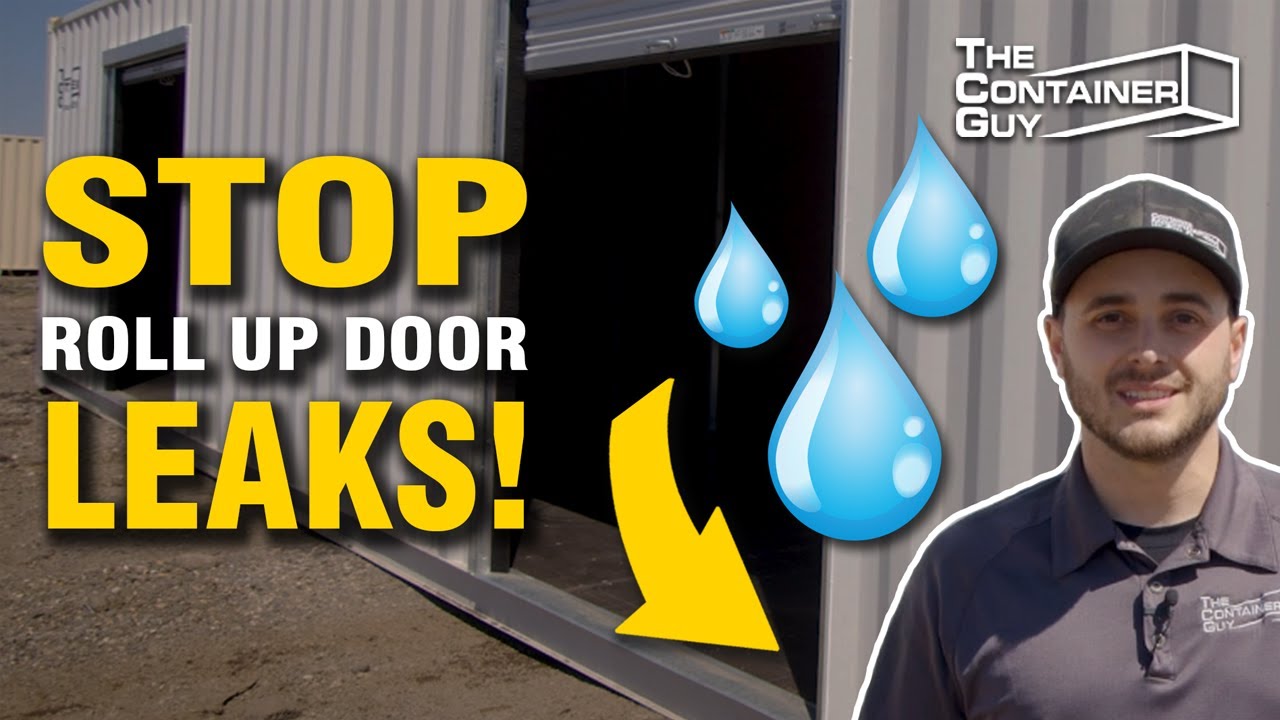
Quality Control on a Roll-Up Door Installation: Preventing Water Leaks in Modified Containers
In this walkthrough, Channing McCorriston, The Container Guy, performs a quality control inspection on a recently modified shipping container equipped with a roll-up door.
During the review, he identifies water leakage issues caused by both installation oversights and the manufacturing characteristics of a lower-spec container. The goal of the inspection is simple: show where things go wrong and explain how to prevent water intrusion when adding roll-up doors to shipping containers.
Why Water Leaks Happen with Roll-Up Doors
Adding a roll-up door improves accessibility, but it changes the container’s original design. Factory container doors are engineered to be wind-, water-, and rodent-tight. A thin 26-gauge sheet metal roll-up door cannot match that performance on its own.
That means installation details matter more than ever.
In this case, two primary factors caused water to enter the container:
-
The container was not sitting level.
-
Silicone sealant was not applied thoroughly along critical edges.
When a container slopes inward even slightly, rainwater will naturally move toward the interior. Without proper sealing and outward drafting, water finds its way in.
The Role of Silicone Sealing
One of the main issues identified during the inspection was incomplete silicone application.
Sealant was not fully applied along:
-
The edges of the door track
-
The joint where the side frame meets the threshold plate
-
The top weld line of the threshold plate
This allowed rainwater to travel underneath the threshold and seep inside the container.
The solution is straightforward but requires attention to detail. All edges must be sealed continuously, without gaps. Even small missed sections can become entry points for water.
The Hidden Problem with Leasing Spec Containers
Beyond installation mistakes, the container itself contributed to the problem.
This unit was a leasing company specification container rather than a high-quality one-time-use container. Leasing spec units are often built with thinner floors and slight structural deviations to reduce costs.
In this case, the floor sat lower than the top channel. That caused the threshold plate to slope inward rather than outward. Instead of shedding water away from the container, the threshold directed water inside.
This inward draft is a critical issue. Even perfect sealing cannot fully compensate for improper slope.
Installation Adjustments That Make a Difference
To avoid similar problems, Channing recommends several key practices:
-
Ensure the container is level before installation
-
Use a level on both the floor and threshold plate
-
Confirm the threshold drafts outward to shed water
-
Seal all edges thoroughly with silicone
-
Inspect for manufacturing variances before final welding
In some cases, grinding the weld along the bottom of the threshold plate may be necessary to achieve proper fit and alignment. While grinding is labor intensive and noisy, it can be essential when working with lower-quality containers.
Installers must be prepared to adjust their standard operating procedures when dealing with leasing spec units.
Understanding the Trade-Off
There is always a trade-off when installing roll-up doors.
You gain convenient side access, but you give up some of the factory-level weather and rodent tightness. Most users accept this compromise, provided the installation is done carefully and correctly.
Proper leveling, correct threshold drafting, and thorough sealing significantly reduce water intrusion risks.
Final Thoughts
This quality control inspection reinforces an important point about container modification. Success depends not only on the framing kit or door itself, but also on container condition and installation precision.
Leasing spec containers may introduce additional challenges that require extra labor and inspection. Installers who take the time to level the container, verify outward draft, and seal every joint properly will dramatically reduce long-term water issues.
Roll-up doors are a valuable upgrade. But as with any modification, attention to detail makes the difference between a dry interior and ongoing frustration.